
No products in the cart.
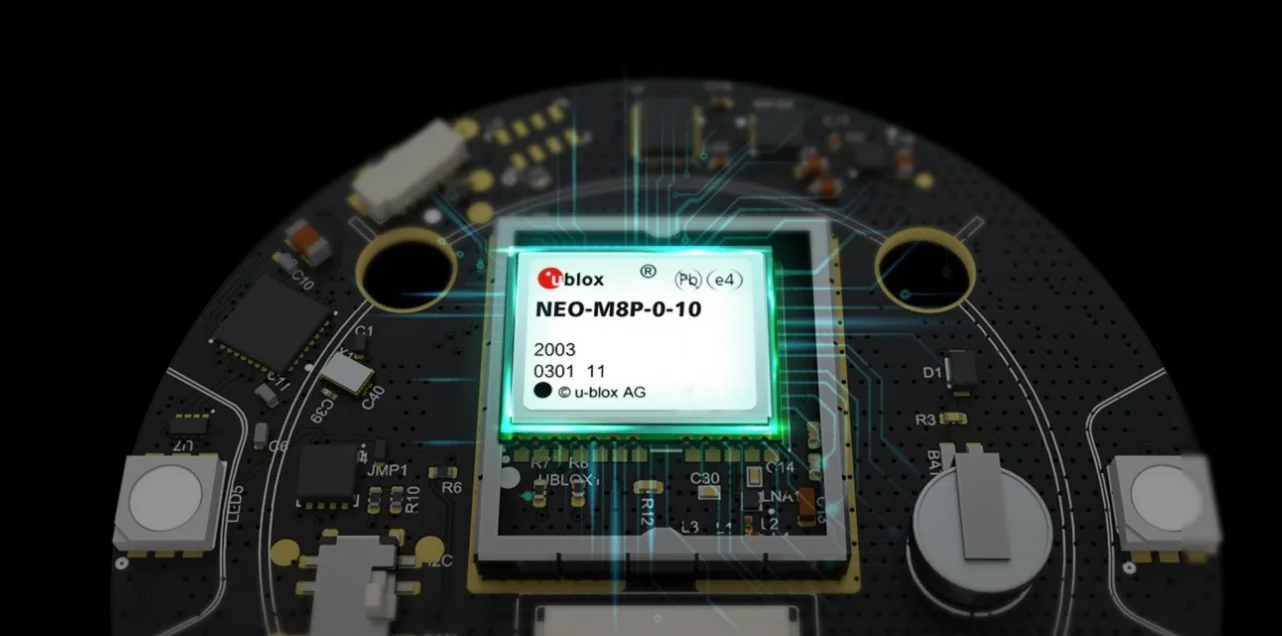
Complete Guide to UAV Electronics Architecture (Autopilot, RTK GNSS, Telemetry & Sensors)
Modern industrial drones rely on complex electronic systems that combine navigation, communication, stabilization, and sensing technologies.
Whether used for aerial mapping, infrastructure inspection, research, or robotics development, professional UAV platforms require reliable and highly integrated electronics. This guide explains the core electronics architecture of modern UAV systems, including autopilots, RTK navigation modules, telemetry links and onboard sensors. It also highlights the key components used by professional UAV developers around the world.
Understanding how these systems work together helps engineers design more reliable drones and select the right hardware for their applications.
Core Components of a Modern UAV Electronics System
A professional drone platform is built around several essential electronic subsystems.
These include:
- flight control systems (autopilot)
- GNSS navigation modules
- telemetry and communication links
- sensors for flight stabilization and navigation
- power management systems
Each subsystem performs a critical function and must integrate seamlessly with the others to ensure safe and stable UAV operation.
1. UAV Flight Controllers (Autopilot Systems)
The flight controller, also called an autopilot, is the central computer of a drone. It processes sensor data, calculates flight dynamics and controls motors and actuators to maintain stable flight.
Industrial UAVs typically use advanced autopilot platforms that support autonomous flight, sensor fusion and integration with multiple peripherals.
Key capabilities of professional UAV autopilots
Modern autopilot systems support:
- autonomous waypoint navigation
- sensor fusion from multiple IMUs
- integration with GNSS and RTK positioning systems
- telemetry communication with ground control stations
- payload control and mission automation
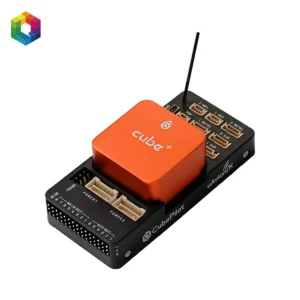
One of the most widely used autopilot platforms in professional UAV development is the CubePilot ecosystem, which includes controllers such as Cube Orange+.
These autopilots feature powerful processors, redundant IMUs and extensive connectivity through CAN, UART and I2C interfaces, making them suitable for complex UAV systems used in research, inspection and mapping.
2. GNSS and RTK Navigation Systems
Accurate positioning is essential for many industrial UAV applications such as surveying, mapping and infrastructure inspection.
Standard GPS positioning typically provides accuracy of several meters, which is insufficient for many professional workflows.
To achieve centimeter-level positioning accuracy, many UAV platforms integrate RTK (Real-Time Kinematic) GNSS systems.
What RTK GNSS does
RTK navigation improves positioning accuracy by combining satellite data with correction signals from a base station.
This allows UAV systems to achieve:
- centimeter-level positioning accuracy
- highly precise waypoint navigation
- improved photogrammetry and mapping results
RTK modules commonly used in UAV systems are based on u-blox F9P GNSS receivers, which support multiple satellite constellations, including:
- GPS
- GLONASS
- Galileo
- BeiDou
Manufacturers such as Drotek produce professional GNSS RTK modules specifically designed for integration with UAV autopilot systems.
These modules communicate directly with the flight controller and provide highly accurate navigation data for autonomous missions.
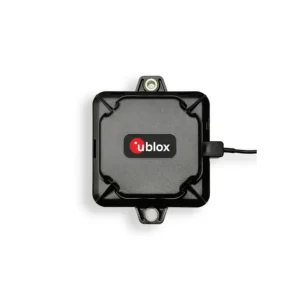
U-blox ANN-MB2 all-band GNSS antenna (L1/L2/L5/E6/B3/L)_ATGroup.store
3. UAV Telemetry and Communication Systems
Communication between a UAV and its ground control station is handled by telemetry systems.
Telemetry links transmit essential flight data such as:
- drone position
- altitude
- system health information
- mission commands
Professional UAV telemetry systems also enable real-time monitoring and control through ground control software such as Mission Planner or QGroundControl.

HX4-06212 Herelink HD Video Transmission System-2
Types of telemetry used in UAV systems
There are several common telemetry technologies used in drone platforms.
Radio telemetry
Traditional telemetry radios operate in the 433 MHz, 868 MHz or 915 MHz bands and provide long-range communication between the drone and ground station.
Digital HD telemetry systems
Newer systems such as Herelink combine telemetry, video transmission and remote control into a single digital communication system.
These systems allow operators to receive HD video and control the drone over long distances with low latency.
Reliable telemetry systems are essential for BVLOS (Beyond Visual Line of Sight) drone operations, which are becoming increasingly common in industrial UAV applications.
4. Sensors Used in UAV Navigation and Stabilization
Modern UAV autopilots rely on multiple sensors to determine the drone’s position, orientation and movement.
These sensors provide the data required for stabilization algorithms and autonomous flight control.
IMU sensors
The Inertial Measurement Unit (IMU) measures acceleration and rotational motion using gyroscopes and accelerometers.
IMUs are the primary sensors used for flight stabilization.
Magnetometers
Magnetometers measure the Earth’s magnetic field and provide heading information for navigation.
Barometers
Barometric pressure sensors measure altitude based on air pressure.
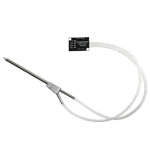
Airspeed sensors
Airspeed sensors measure airflow over the aircraft and help improve flight stability, particularly in fixed-wing UAVs.
GNSS receivers
GNSS receivers determine the drone’s global position using satellite signals.
By combining data from all of these sensors, the autopilot can create a highly accurate model of the drone’s position and orientation.
5. Power Management and Peripheral Integration
Another important part of UAV electronics architecture is power distribution and peripheral connectivity.
Professional flight controllers typically connect to several additional components including:
- ESC motor controllers
- servos
- cameras and payloads
- telemetry radios
- GNSS modules
Power management boards or power bricks ensure that these systems receive stable voltage while also monitoring battery consumption.
Reliable power management is essential for safe UAV operation and helps prevent system failures during flight.
Example Architecture of an Industrial UAV System
A typical professional UAV platform may include the following electronics configuration:
Flight controller
CubePilot Cube Orange+
Navigation system
RTK GNSS module based on u-blox F9P
Telemetry
Digital telemetry system such as Herelink
Sensors
IMU, magnetometer, barometer and airspeed sensor
Power system
Power distribution board and ESC motor controllers
This modular architecture allows engineers to build highly capable UAV platforms that can be adapted to different mission requirements.
Why Modular UAV Electronics Matter
One of the key advantages of modern UAV systems is their modular architecture.
Instead of relying on proprietary closed systems, many drone developers choose open platforms that allow them to integrate different components and customize their hardware stack.
Benefits of modular UAV electronics include:
- flexibility in hardware selection
- easier upgrades and maintenance
- compatibility with open flight software such as ArduPilot or PX4
- ability to integrate specialized sensors and payloads
This approach is widely used in research, robotics and industrial UAV development.
Professional UAV Components at ATGroup.store
ATGroup.store supplies professional UAV electronics used by drone developers, robotics engineers and research institutions.
The store offers a wide range of components including:
- CubePilot autopilot systems
- GNSS RTK navigation modules
- telemetry communication systems
- UAV sensors and electronics
These components allow engineers to build reliable and high-performance UAV platforms for industrial applications.
The Future of UAV Electronics
The next generation of drones will rely even more heavily on advanced electronics and sensor integration.
Emerging technologies such as:
- AI-based navigation
- autonomous inspection drones
- BVLOS drone operations
- robotics integration
will require powerful autopilots, precise GNSS positioning and reliable communication systems.
Understanding the architecture of UAV electronics is therefore essential for anyone designing or operating professional drone platforms.
Conclusion
Modern UAV platforms rely on a sophisticated electronics architecture that integrates flight control, navigation, telemetry and sensing technologies.
Key components such as autopilots, RTK GNSS modules, telemetry systems and sensors work together to ensure reliable and precise drone operation.
By selecting high-quality components and designing a modular architecture, engineers can build UAV systems capable of supporting a wide range of industrial and research applications.